

Blogs
ــــــــــــ
Car Shipping Tips
What’s The Better Option for Car Shipping? – Car Shipping Tips
If you ever need to move a car from one country to another, you’ll ask yourself the question: “What’s the better option for shipping my car?”
The truth is there’s not a unique answer, the best option for you is the one that meets your needs. To help you we are going to present you the three existing options and you can evaluate what’s the best for your situation.
Types of Transport Available: Ship vehicles using one of three methods—ocean freight containers, roll-on-roll-off vessels, or air freight.
Option 1: Containerized Shipping (by sea)
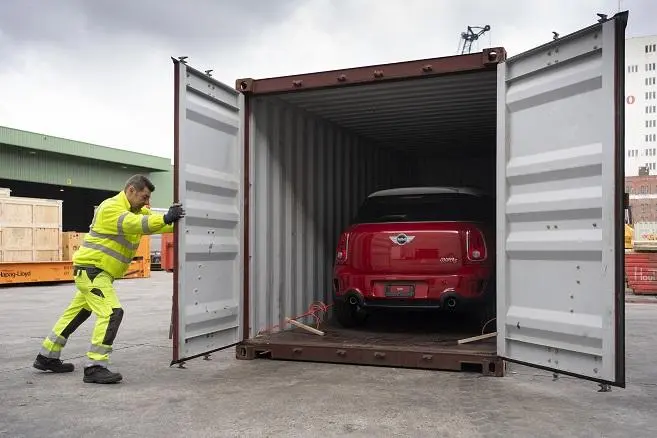
There are global rules for Containerized Car Shipping. They ensure proper blocking and bracing of the car in the container, with no more than six small cars in a standard 40′ container (yours and five others).
Ensure a highly experienced packing professional handles this to avoid any damage to your car by Sea Freight.
Option 2: Roll-on/Roll-Off (RORO) (by sea)
In the RORO process, the car goes into specialized vessels and is lashed down inside the ship.
With RORO your car will be safe and ready to get to its destination.
Rolling the car in and out is simpler than containerizing it, allowing port employees to handle the process and reducing costs by eliminating the need for specialized packing personnel.
Option 3: Air Freight
If you are searching for fast car shipping, Air Freight should be your choice.
The car goes safely inside the cargo plane and gets to the final destination a lot faster than by sea. The costs are significantly higher, but that’s a cost-benefit relationship.
Whatever your need is, you can count on GCE to handle it with excellence! Contact GCE.
Read More Car Shipping Tips:
Importer of Record and Exporter of Record – IOR and EOR
When it comes to global trade, two important roles often cause confusion: Importer of Record (IOR) and Exporter of Record (EOR). These roles are essential for ensuring that international shipments follow legal and regulatory requirements. Before diving into the differences, it helps to first understand what is an IOR and the legal obligations each role carries.
What is IOR and EOR — and When Do You Need Each?
- Importer of Record (IOR): Legally responsible for handling all aspects of importing goods into a country — paying taxes, duties, and fees, ensuring compliance with local regulations, and acting as the official representative with customs. Businesses without a physical presence in the destination country typically rely on Importer of Record services to handle this role on their behalf.
- Exporter of Record (EOR): Carries the same legal weight but at the export end. The EOR ensures goods leaving a country meet all legal requirements, files export declarations, manages export licenses, and prevents customs delays at origin.
You need an IOR when:
- You are shipping into a country where you have no registered legal entity
- The destination requires a locally accredited entity to file a customs entry and pay duties
- Goods are subject to import licenses or product approvals in the destination country
- You are deploying IT or telecoms equipment into a new market without a local office
You need an EOR when:
- You are exporting from a country where you have no registered entity
- Your goods require export licenses, end-user certificates, or dual-use export controls
- You need to file export declarations and ensure the shipment departs legally
- Your customer wants you to manage all export compliance obligations at the origin
You need both when:
- You are managing a cross-border deployment where both ends need a legally responsible entity
- You are running a global IT rollout across multiple origin and destination countries
- Your shipment involves controlled, dual-use, or high-value goods requiring compliance management at both export and import stages
Key Responsibilities of IOR and EOR
IOR and EOR services provide a single organization to meet international trade requirements, ensuring faster, simpler, and more reliable importing and exporting worldwide. Every shipment is assigned an IOR number — a unique identifier registered with the destination customs authority that ties all import declarations to the responsible entity. Understanding IOR customs compliance obligations upfront is what separates businesses that clear customs smoothly from those that face holds, penalties, and reassessments.
The company providing IOR and EOR services can act as either the owner or the purchaser/seller of foreign merchandise, and may also serve as a customs broker with power of attorney (POA) to act on behalf of the importer
Importer of Record (IOR)
full details of IOR customs responsibilities:
- Classifying and valuing goods before import using the correct HS code classification under the Harmonized System.
- Ensuring all customs requirements are met.
- Paying duties, taxes, and tariffs.
- Submitting necessary declarations to government agencies.
- Preparing permits, certifications, and all freight documents required for customs clearance.
Exporter of Record (EOR)
full details of EOR responsibilities:
- Managing the entire export process from origin classification to declaration filing.
- Ensuring goods comply with export regulations — including international export payment methods and financial terms that affect export compliance obligations.
- Handling export declarations and documentation.
- Coordinating with customs for smooth shipment departure.
Benefits of Using IOR/EOR Services
Using a dedicated IOR or EOR service delivers clear operational advantages — from the benefits of IOR service like eliminating the need for a local legal entity, to faster clearance, full regulatory compliance, and reduced risk of shipment delays.
- Faster customs clearance and smoother shipments
- No need to set up a legal entity in another country
- Full compliance with local import/export laws
- Reduced risk of shipment delays due to regulatory issues
Combined IOR + EOR Solutions
For businesses managing global deployments — particularly in technology, telecoms, and industrial sectors — a single provider covering both IOR and EOR eliminates the most common failure points in cross-border shipments.
| Stage | IOR | EOR |
|---|---|---|
| Export declaration at origin | — | ✓ |
| Export license management | — | ✓ |
| Carrier booking & freight management | ✓ | ✓ |
| Import customs entry at the destination | ✓ | — |
| Duty & tax payment | ✓ | — |
| Import permits & product approvals | ✓ | — |
| Post-clearance audit liability | ✓ | — |
| End-to-end compliance accountability | ✓ | ✓ |
Common use cases:
- Global IT rollouts: Deploying network infrastructure across multiple countries requires an EOR at origin and an IOR at each destination — often under tight project deadlines.
- Cross-border equipment transfers: Moving leased or refurbished equipment needs export clearance at origin and import compliance at destination, often with temporary admission provisions.
- E-commerce fulfillment into new markets: Expanding into a new country requires an IOR to clear inbound stock into a local fulfillment center and potentially an EOR to manage returns.
- Controlled and dual-use goods: Telecoms hardware, encryption software, and industrial equipment may require export licenses at origin, and import permits at destination — both must be confirmed before the shipment moves.
Final Thoughts
Working with a trusted IOR/EOR service ensures compliance, efficiency, and peace of mind across every cross-border shipment. Combined with freight forwarding services that manage the physical movement of goods, a full-service provider gives you a single point of contact from origin to final delivery.
Frequently Asked Questions
Can the same company be both the IOR and the EOR?
Yes. A single provider can act as both IOR at the destination and EOR at the origin. This is the most efficient arrangement for cross-border deployments, giving the shipper a single point of accountability for the entire transaction.
Do I need an IOR if I already have a local entity in the destination country?
Not necessarily. If your local entity holds the necessary customs accreditation, it can act as its own IOR. However, many companies use a third-party IOR service even where a local entity exists, to keep customs liability separate from their operating company.
What happens if there is no IOR on a shipment?
Without a designated IOR, customs authorities cannot process the import entry. The shipment will be held at the port and may face storage charges, penalties, or return to origin if an IOR is not appointed within the required timeframe.
What is an IOR number, and why does it matter?
An IOR number is a unique identifier assigned to the Importer of Record by the destination customs authority. It appears on all import declarations and ties compliance liability to a specific registered entity. Without a valid IOR number, a formal customs entry cannot be filed.
Is an EOR the same as a freight forwarder?
No. A freight forwarder arranges the physical movement of goods. An EOR carries the legal compliance responsibility for the export — filing declarations, managing export licenses, and ensuring goods are legally authorized to leave. A forwarder can sometimes also act as EOR, but the two roles are legally distinct.
When should I use a combined IOR + EOR service?
Use a combined service when managing end-to-end cross-border shipments — particularly for global IT deployments, equipment transfers, or e-commerce expansion — and you want a single provider accountable for compliance at both origin and destination.
How long does it take to set up IOR or EOR coverage in a new country?
For standard commercial goods, IOR coverage can typically be established within a few days. For regulated goods requiring import licenses or product approvals, setup can take several weeks. Always confirm lead times with your provider before committing to a shipping date.
Tips for Smooth Sailing When Shipping Cars Internationally
Shipping vehicles overseas can appear to be a daunting task. True, there are many factors to consider but selecting a reliable, auto shipping partner can help to eliminate your concerns. These 10 Top Tips for shipping cars overseas can guide you through the process, helping to make your international auto transport experience worry-free.

Find a Company that Specializes in Shipping Cars Overseas
1. First and foremost, contract with a reputable, reliable car shipping company. Taking time upfront can save you aggravation in the end. Ensure that the company you choose registers with the Federal Maritime Commission (FMC).
2. Be sure to insure. Every year, thousands of containers go missing at sea, but millions arrive safely and on time. Even though the vast majority of cars arrive undamaged, don’t take anything for granted. International shipping companies must have adequate freight insurance policies, but you need to verify these policies and check their coverage limits. You want to know that their policy will cover the value of your vehicle in case of loss. Additionally, ask about damage coverage and other options that not all shippers offer.
3. Comparison shop before shipping. The cost of shipping your vehicle may differ according to its classification, age, model, and other factors such as your destination. Whether or not you have additional insurance coverage can also be a factor. Obtain more than one international shipping quote before deciding on the company that best suits your specific needs.
4. Contrary to popular belief, we don’t live in a paperless world! As you prepare your car for shipping, be sure to keep copies of all essential paperwork associated with the journey. At a minimum you will need a notarized copy of the car title, a letter from the lien holder if a lien exists, and a Shipper Export Declaration form.
Prepare Your Car for Shipping

5. Keep it clean. A reliable, international car shipping company will advise you to thoroughly clean your vehicle before it is picked up and loaded onto the ship. After careful handling, you can then expect your car to arrive in good order at its final destination.
6. Get keyed up! Don’t forget to make a second copy of your car key, one for you and one for the shipper. If keys are misplaced or lost during transport, they could be hard to find on a large container vessel!
7. Schedule ahead. Arrange for your car to be picked up or dropped off in advance of your expected departure date. Some companies will pick you up from your home, or if you are purchasing a new car, they may even transport the car directly from the dealership. Other international car shippers maintain designated drop-off locations that may be suitable for your requirements. Depending on your exact destination, you may need to have your car picked up from a shipping terminal.
8. Plan your time. The amount of time required to ship your car internationally depends on where your journey begins and ends. For instance, if you are shipping a vehicle from the US to a country in the Middle East, your car will probably need to pass through multiple ports with different customs procedures. A reliable shipping company will advise you of the time needed, usually a few weeks, for your car to be at your destination before you arrive.

Find a Company with Reliable Auto Shipping Partners
9. Customs. The only thing customary about customs is that the procedures differ country by country and port by port. Attempting customs on your own can be frustrating, cause delays, and even result in increased costs. Since most international car shipping companies work with customs brokers, it makes sense to select a company that can efficiently provide this service for you.
10. Check the condition of your car. Cars that do not start or cannot be driven can still be shipped overseas, although the cost may vary depending on the amount of labor needed to move and handle the vehicle.
Read More Related Blogs: