

What is HS Code? Definition of Harmonized System Code
HS Code, or the Harmonized Commodity Description and Coding System — also known as the Harmonized System (HS) — is the international standardized system of product names and numbers used to classify traded goods.
HS Code Definition according to WCO:
The Harmonized Commodity Description and Coding System, generally referred to as the “Harmonized System” or simply “HS,” is a multipurpose international product nomenclature developed by the World Customs Organization (WCO).
HS comprises about 5,000 commodity groups, each identified by a six-digit code, arranged in a legal and logical structure, and supported by well-defined rules to achieve uniform classification. This system is used by more than 200 countries and economies as a basis for their customs tariffs and for the collection of international trade statistics. Over 98% of the merchandise in international trade is classified in terms of the HS.
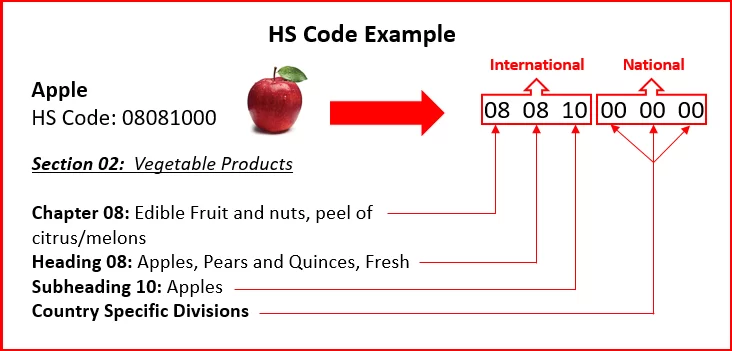
How is an HS Code Structured?
Every HS code follows the same structure. The first six digits are internationally standardized. Countries then add their own digits (typically 2–4 more) for national tariff and statistical purposes.
Example code: 8471.30.00.10
| Digits | Segment | What it means |
|---|---|---|
| 84 | Chapter | Nuclear reactors, boilers, machinery & mechanical appliances |
| 71 | Heading | Automatic data processing machines (computers) |
| .30 | Subheading | Portable machines ≤ 10kg (laptops, tablets) |
| .00.10 | National digits | Country-specific tariff & statistical breakdown |
The first 6 digits (847130) are the same in every country. The remaining digits vary by jurisdiction — the EU uses 8 digits (CN), the US uses 10 digits (HTS), the UK uses 10 digits, and Gulf countries (GCC) use 8 digits.
Real HS Code Examples
Example 1 — Laptop Computer
| HS Code | 8471.30 |
| Chapter | 84 — Machinery and mechanical appliances |
| Heading | 8471 — Automatic data-processing machines |
| Subheading | 8471.30 — Portable, weight ≤ 10 kg |
| Used for | Laptops, notebooks, tablets with keyboards |
Example 2 — Industrial Router / Network Switch
| HS Code | 8517.62 |
| Chapter | 85 — Electrical machinery and equipment |
| Heading | 8517 — Telephone sets; apparatus for transmission |
| Subheading | 8517.62 — Machines for reception, conversion, and transmission |
| Used for | Routers, switches, and network hubs |
Example 3 — Medical Face Masks
| HS Code | 6307.90 |
| Chapter | 63 — Other made-up textile articles |
| Heading | 6307 — Other made-up articles |
| Subheading | 6307.90 — Other (includes face masks) |
| Used for | Surgical and protective face masks |
HS Code History
Due to the lack of uniformity between the many different classification systems around the globe, the fragmentation has become a major concern for international trade. Several attempts were made to create a unified international classification system. In 1988, most World Customs Organization (WCO) members adopted the new Harmonized System, which came into effect immediately.
After WCO adoption, the HS became the backbone of global trade compliance. Understanding why the Harmonized Tariff Schedule matters for importers is essential for any business shipping goods across borders.
What are the applications of HS Codes?
HS codes are used by customs authorities, statistical agencies, market research agencies, and government bodies worldwide. They are central to Importer of Record services that handle HS code classification and the monitoring and control of imported and exported commodities through:
- Transport tariffs and statistics
- Collection of internal taxes
- Monitoring of controlled goods
- Customs tariffs
- Collection of international trade statistics
- Import and export monitoring by customs and statistical authorities
- Rules of the country of origin
- Trade negotiations
- Risk assessment and customs compliance obligations for importers shipping IT equipment
- Many companies also use HS codes to calculate the total landed cost of imported products, as well as to identify selling and sourcing opportunities.
How to Find & Look Up Your HS Code — Complete Guide
Finding the right HS code is not guesswork — it follows a structured process. Incorrect classification is one of the most common causes of customs delays, duty overcharges, and compliance penalties. Use the methods and steps below to get it right the first time.
Method 1 — Use an official online lookup tool.
These are the most direct starting points:
- WCO HS Online — browse the full international HS nomenclature
- US Census Commodity Classifier — for US HTS codes (10 digits)
- UK Trade Tariff — for UK commodity codes
- EU TARIC — for EU CN codes
- GCC Customs Portal — for UAE and Gulf imports
Method 2 — Search by product keyword
Enter a plain-language product description into the lookup tool. Start broad (e.g., “router”), then narrow using the subheading descriptions. Always read the chapter and section notes — they are legally binding and can override what the heading text seems to say.
Method 3 — Check existing shipment documents.
If you have previously shipped the same product, the HS code will appear on past commercial invoices, customs entries, or certificates of origin. Verify the code is still current — the WCO updates the HS every five years (last update: 2022, next: 2027).
Method 4 — Request a Binding Tariff Information (BTI) ruling.
For high-value or high-volume shipments, apply for a BTI from your country’s customs authority. A BTI is a legally binding written decision on the correct HS code for your specific product. It protects you from reclassification and gives certainty for duty calculation. Processing takes 30–90 days, depending on jurisdiction.
Method 5 — Work with an IOR or freight forwarder.
For complex goods — especially IT equipment, telecoms hardware, pharmaceuticals, or dual-use items — classification should be handled by a specialist. Freight forwarding services that ensure correct HS code filing and Importer of Record services that handle HS code classification carry the compliance responsibility, so misclassification risk does not sit with you.
Common mistake: Many shippers copy HS codes from supplier invoices without verifying them. The supplier’s code may be correct for their country of export but wrong for your country of import — the national digits differ, and sometimes the subheading itself changes by jurisdiction.
Once you have a candidate code, verify it in 7 steps:
Step 1 — Describe your product precisely.
Write out the full product description — what it is made of, what it does, how it is used, and whether it is for commercial or personal use. Vague descriptions like “electronic device” are not sufficient.
Step 2 — Identify the chapter.
The WCO HS is divided into 21 sections and 99 chapters. Start broad — is your product a machine (Ch. 84–85), a textile (Ch. 50–63), a chemical (Ch. 28–38)?
Step 3 — Narrow to the heading (4 digits).
Within your chapter, find the heading that most specifically describes your product. Read the section and chapter notes — these are legally binding and override the heading text.
Step 4 — Select the subheading (6 digits).
The first 6 digits are your internationally valid HS code. This is the minimum required on shipping documents.
Step 5 — Extend to your destination country. ‘
Add the national digits required by your import/export country (8 digits for EU/GCC, 10 digits for US/UK).
Step 6 — Verify with a binding ruling if unsure.
For high-value or high-volume shipments, request a BTI ruling from customs for legal certainty.
Step 7 — Document your classification rationale.
Keep a record of why you chose a specific code. This is your audit trail if customs queries the classification.
If you are shipping IT equipment, telecoms hardware, or controlled goods into the Middle East or EU, misclassification risks go beyond delayed shipments — they can trigger import bans and penalties. Working with an IOR service that manages classification is the safest approach.
How HS Codes Impact Duties and Costs
The HS code assigned to your shipment is not just a reference number — it directly determines how much you pay and whether your goods clear customs at all.
1. Import duty rate.
Every HS code maps to a specific duty rate in each country’s tariff schedule. Two nearly identical products classified under different subheadings can carry duty rates of 0% and 25%, respectively. Getting the code wrong — even by one digit — can mean paying the wrong rate or triggering a customs query.
2. Trade agreement eligibility
Free trade agreements (FTAs) grant preferential (reduced or zero) duty rates, but only for specific HS codes. If your code is wrong, your shipment may be denied preferential treatment even if the product qualifies — and you would pay the full Most Favored Nation (MFN) rate instead.
3. VAT and excise treatment.
In many countries, VAT rates and excise duty rules are tied to HS classifications. Pharmaceutical products, food items, and children’s goods often carry reduced or zero VAT — but only when classified correctly.
4. Import licensing and permits
Certain HS codes trigger mandatory import licenses, inspection requirements, or restricted-goods controls. Electronics, chemicals, medical devices, and dual-use technology all have HS codes that flag additional compliance steps. Misclassifying a controlled item under a non-controlled code is a customs offense, not just an administrative error. This is why understanding how the Importer of Record uses HS codes to clear customs — including managing import and export monitoring obligations — is critical for any business without a local entity in the destination country.
5. Landed cost calculation
Total landed cost = product cost + freight + insurance + import duty + VAT + handling fees. The duty component — calculated directly from the HS code — can swing total landed cost by 5–30% depending on the product and destination. Accurate classification at the quoting stage prevents budget surprises at the border.
6. Dumping and safeguard duties
Anti-dumping duties and safeguard tariffs are applied at the HS code level. A product entering under an affected code may face additional duties of 20–100% on top of the standard rate. These change frequently — another reason to verify codes against current tariff schedules before each shipment.
HS Code Major Resources Available for Traders
There are several resources available to traders to assist in properly classifying their goods:
- The Official Explanatory Notes to the Harmonized System, published by the World Customs Organization
- The US Census “Classify your Commodity” engine: uscensus.prod.3ceonline.com
- Explanatory Notes to the Combined Nomenclature of the European Union, by the European Commission
- Customs Rulings Online Search System (CROSS), by U.S. Customs and Border Protection
- Binding Tariff Information (BTI), by the European Commission
- Informed compliance publications by U.S. Customs and Border Protection
- Classification Guides, by HM Revenue & Customs
Getting HS codes right at the origin saves high cost and time at the destination. Working with freight forwarding services that ensure correct HS code filing means classification is handled before the shipment moves, not corrected after a customs hold.
HS codes appear on the commercial invoice, packing list, bill of lading, and customs entry. For a full overview of how they interconnect, see the key freight documents that rely on accurate HS codes.
Frequently Asked Questions
Is the HS code the same as the HTS code?
Not exactly. The HTS (Harmonized Tariff Schedule) is the US-specific extension of the HS. The first 6 digits are the same internationally; the US adds 4 more digits for a 10-digit HTS code used for duty and statistical purposes.
Who is responsible for assigning the correct HS code?
The importer of record is legally responsible for the correct HS code classification. If a supplier provides a wrong code on a commercial invoice, it is still the importer’s liability at the destination customs authority.
What happens if I use the wrong HS code?
Consequences range from shipment delays and re-examination to penalty duties, fines, and, in serious cases, seizure of goods. Intentional misclassification to avoid duties is treated as customs fraud.
Do HS codes change?
Yes. The WCO revises the HS every five years. The most recent revision was HS 2022. New product categories (including emerging technologies) are added, and existing classifications are updated. Always verify codes against the current edition before shipping.
Can the same product have different HS codes in different countries?
The first 6 digits should be the same globally. However, the national digits (7–10) differ by country, and in rare cases, customs authorities interpret subheadings differently. When in doubt, verify locally.
Does the HS code affect whether I need an import license?
Yes. Certain HS codes trigger mandatory import licenses, end-user certificates, or restricted-goods controls — particularly for electronics, chemicals, medical devices, and dual-use items. Always check the destination country’s licensing requirements before shipping.
What is a Binding Tariff Information (BTI) ruling?
A BTI is a formal, written decision issued by a customs authority confirming the correct HS code for a specific product. It is legally binding for 3 years and protects the importer against reclassification. It is available in the EU, UK, US, and most major trading jurisdictions.
Deepen your knowledge and read the primary purpose of Hts