

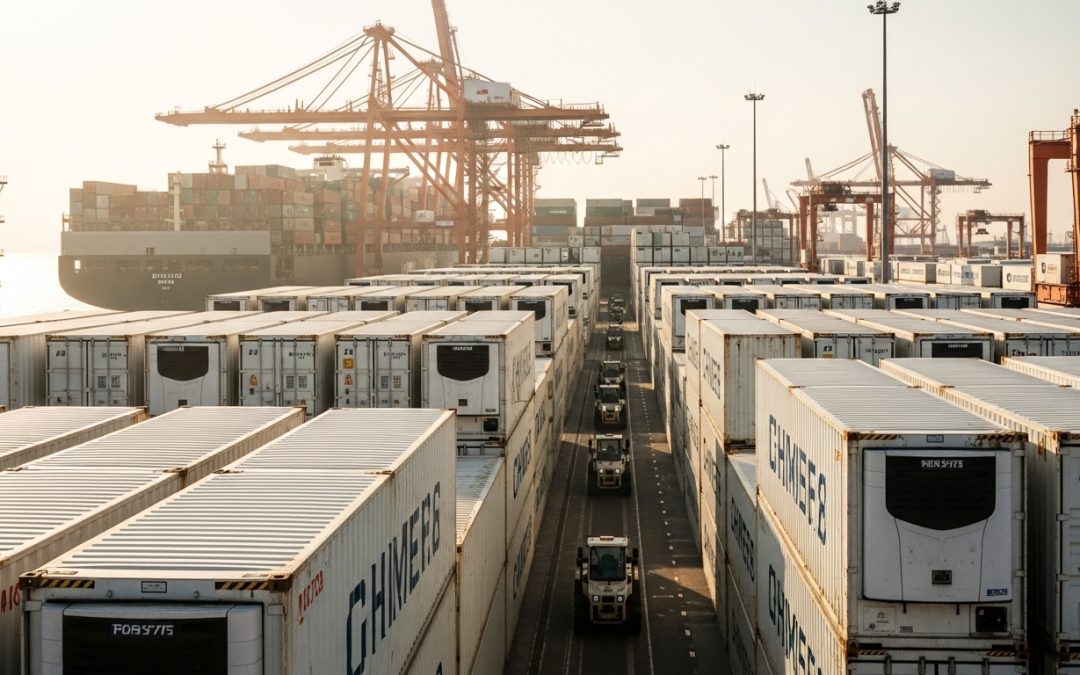
Temperature-sensitive cargo does not fail gradually — it fails suddenly. A short power interruption, incorrect airflow, or a few degrees outside tolerance can turn fresh produce into waste, compromise pharmaceutical shipments, or trigger regulatory non-compliance.
This is where reefer containers play a critical role in global logistics.
A reefer container is not simply a “cold box.” It is a controlled transport environment designed to maintain precise temperature, airflow, and, in some cases, humidity conditions throughout international shipping journeys. From long-haul ocean transport to inland distribution, reefer containers form the backbone of modern cold-chain logistics for food, pharmaceuticals, and specialty goods.
Understanding how reefer containers work — and their operational limitations — is essential for any business shipping temperature-sensitive cargo.
What Does Reefer Container Mean?
A reefer container (short for refrigerated container) is an insulated shipping container equipped with an integrated refrigeration unit that maintains cargo at a defined temperature range during transport.
It is used across sea, road, and rail movements to protect goods that cannot tolerate heat, cold, or uncontrolled environmental conditions.
Important clarification:
- A reefer container refers to the equipment
- Reefer cargo refers to the temperature-sensitive goods inside
Why Reefer Containers Matter in Global Shipping?
Cold-chain logistics is not optional for certain goods — it is a regulatory, safety, and quality requirement.
Reefer containers enable:
- Long-distance transport without breaking temperature integrity
- Compliance with food safety and pharmaceutical regulations
- Reduced spoilage, waste, and cargo claims
- Predictable quality upon arrival, even across complex routes
Without proper reefer handling, temperature-sensitive cargo faces elevated risk at ports, during transshipment, and in hot or unstable climates.
How Does a Reefer Container Work?
A common misconception is that reefer containers cool warm cargo. In reality, they are designed to maintain a preset temperature rather than restore it, which is why cargo must be properly pre-cooled before loading.
How the system functions:
- Refrigeration unit
Mounted at the front of the container, controlling temperature and airflow. - Power supply
Electricity is provided by the vessel, port terminals, or diesel gensets during inland transport. - Air circulation (T-floor system)
Cold air is pushed under the cargo through floor channels and circulated evenly. - Temperature regulation
Sensors continuously monitor and adjust conditions to stay within set parameters.
Key Features That Protect Cargo Integrity
Reefer containers include specialized features designed to reduce cargo risk:
- Temperature control – Precise set points for chilled and frozen goods
- Ventilation settings – Fresh air exchange to manage respiration in the produce
- Humidity control – Reduces dehydration, condensation, and mold risk
- Drainage systems – Prevent moisture accumulation
- Monitoring & data logging – Records temperature history for audits and claims
What Are Reefer Containers Used For?
Reefer containers support a wide range of industries:
Food & perishables
- Fruits, vegetables, meat, seafood, dairy
Pharmaceuticals & healthcare
- Medicines, vaccines, biologics
Chemicals & specialty goods
- Temperature- or humidity-sensitive materials
Non-Operating Reefer (NOR)
- Reefer containers are used as insulated units for dry cargo when cooling is inactive
Reefer Container Temperature Ranges
Temperature requirements for reefer cargo vary significantly by product type, sensitivity, and regulatory classification. The table below outlines typical operating temperature ranges, along with their relative sensitivity levels and key handling considerations that directly impact cargo integrity.
| Cargo Category | Typical Temperature Range | Sensitivity Level | Key Handling Notes |
| Fresh fruits & vegetables | +2°C to +8°C | High | Requires controlled airflow and ventilation to manage respiration |
| Chilled food products | 0°C to +4°C | Medium–High | Stable temperature critical to prevent bacterial growth |
| Frozen food | −18°C to −25°C | Medium | Temperature deviations may cause texture and quality loss |
| Pharmaceuticals (cold chain) | +2°C to +8°C | Very High | Regulatory compliance and continuous monitoring required |
| Pharmaceuticals (controlled room temp) | +15°C to +25°C | High | Sensitive to heat spikes during port and inland handling |
| Specialty chemicals | Cargo-specific | Variable | Temperature limits defined by MSDS and shipper instructions |
Reefer Container Sizes & Specifications
Reefer container dimensions and payload capacities vary slightly by manufacturer, but the configurations below represent industry-standard specifications commonly used in international sea freight. Understanding these differences helps shippers select the correct container type based on cargo weight, volume, and airflow requirements
| Container Type | Internal Length | Internal Width | Internal Height | Approx. Volume | Max Payload | Typical Use Case |
| 20ft Reefer | ~5.4 m | ~2.3 m | ~2.2 m | ~28 m³ | ~27,500 kg | Dense, heavy chilled or frozen cargo |
| 40ft Reefer | ~11.6 m | ~2.3 m | ~2.2 m | ~59 m³ | ~29,000 kg | Standard volume of perishables |
| 40ft High Cube Reefer | ~11.6 m | ~2.3 m | ~2.5 m | ~67 m³ | ~29,500 kg | Light, high-volume pharma or produce |
Reefer Containers vs Dry Containers
While reefer and dry containers may appear similar externally, their operational requirements, risk profiles, and cost structures differ substantially. The comparison below highlights the key functional and logistical differences that determine when a reefer container is required.
| Criteria | Reefer Container | Dry Container |
| Temperature control | Active refrigeration with precise set points | No temperature control |
| Power dependency | Continuous (vessel, terminal, genset) | Not required |
| Cargo preparation | Requires pre-cooling and loading discipline | Minimal preparation |
| Monitoring & data logging | Standard requirement | Not applicable |
| Compliance exposure | High (food & pharma regulations) | Low |
| Cost structure | Higher due to equipment, power, and monitoring | Lower operational cost |
| Risk profile | High if mismanaged | Low for general cargo |
Operational Challenges of Reefer Containers
Reefer containers are highly effective at protecting temperature-sensitive cargo, but they also introduce additional operational complexity compared to standard dry containers. Most reefer-related issues do not stem from equipment failure alone, but from power, handling, or monitoring gaps along the shipping journey.
Understanding these challenges helps shippers reduce risk and avoid preventable cargo losses.
Key operational challenges include:
-
Continuous power dependency
Reefer containers rely on uninterrupted electricity from vessels, terminals, or gensets. Any power disruption during port stays, transshipment, or inland transport can lead to temperature deviations.
-
Higher operating costs
Compared to dry containers, reefers incur additional costs related to equipment, energy consumption, monitoring, and specialized handling at ports and terminals.
-
Pre-cooling requirements
Reefer containers are designed to maintain temperature, not reduce it. If cargo is loaded warm or unevenly cooled, the container cannot correct the temperature, increasing the risk of quality damage.
-
Airflow and stowage sensitivity
Improper loading or blocked air channels can prevent cold air from circulating evenly, creating hot spots inside the container even when the unit is functioning correctly.
-
Monitoring and compliance exposure
Food and pharmaceutical shipments often require documented temperature records. Inadequate monitoring or missing data logs can lead to shipment rejection or disputes, even if the cargo arrives in acceptable condition.
-
Port delays and climate exposure
Extended dwell times at ports, especially in hot climates, increase the strain on reefer units and heighten the importance of reliable power and supervision.
⚠️ Important: Most reefer cargo losses occur during loading, port handling, or power transitions — not while the vessel is at sea.
Reefer Containers in the EU & Middle East
Cold-chain shipping in the EU and the Middle East presents specific challenges:
- Strict food safety and pharmaceutical import regulations
- High ambient temperatures in the Gulf and regional markets
- Variability in port infrastructure and power availability
- Greater importance of experienced logistics planning
Shipping Temperature-Sensitive Cargo with Confidence
Reefer containers are essential for protecting temperature-sensitive cargo — but success depends on correct setup, continuous power, and expert handling. Understanding how reefers work, their limitations, and best practices helps reduce risk and maintain cargo integrity across international supply chains.
FAQs
How cold can a reefer container get?
Most modern reefer containers can operate at temperatures as low as −25°C, depending on the equipment and configuration. The exact setting depends on the cargo type and the shipper’s requirements.
Do reefer containers cool cargo from warm temperatures?
No. Reefer containers are designed to maintain an already stable temperature, not to cool warm cargo. Products must be properly pre-cooled before loading to ensure temperature integrity during transport.
How are reefer containers powered during shipping?
Reefer containers are powered by electricity supplied by the vessel while at sea, by shore power at terminals, or by diesel gensets during inland transport. Continuous power availability is essential to maintaining temperature control.
Are reefer containers more expensive than dry containers?
Yes. Reefer containers typically cost more due to specialized equipment, energy consumption, monitoring requirements, and additional handling at ports and terminals. These costs reflect the higher level of protection required for temperature-sensitive cargo.
What happens if a reefer container loses power?
If power is interrupted, the internal temperature may begin to drift outside the set range. The impact depends on factors such as cargo sensitivity, ambient conditions, and the duration of the outage. Continuous monitoring helps identify and manage such incidents early.
Can reefer containers be used for non-perishable goods?
Yes. Reefer containers can be used as non-operating reefers (NOR) to transport dry cargo that benefits from insulation or requires separation from general cargo, even when the refrigeration unit is not active.
Are reefer containers suitable for pharmaceutical shipments?
Yes, when properly configured and monitored. Reefer containers are commonly used for pharmaceutical and healthcare products, provided that temperature settings, documentation, and handling procedures meet regulatory and quality requirements.
Recent Comments