

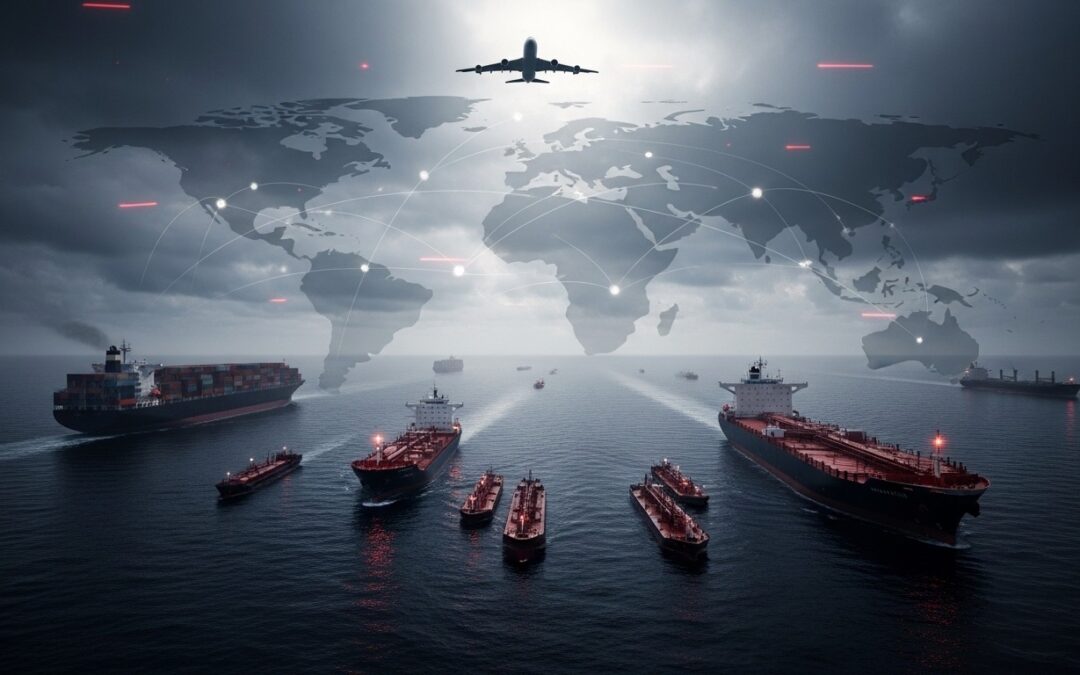
The Crisis That Changed Everything Overnight On March 2, 2026, Iranian forces attacked commercial vessels attempting transit through the Strait of Hormuz. Within 48 hours, Brent crude surged 13%. At least 150 tankers and container ships dropped anchor in surrounding waters. Five of the world’s largest marine insurers cancelled war risk coverage for Gulf operations. The freight markets, tanker, ocean container, and air cargo have not recovered. This is not a temporary disruption waiting to self-correct. The Strait of Hormuz, the world’s single most critical maritime chokepoint, is now effectively closed to commercial traffic. What follows is a precise account of what that means for freight rates, supply chains, and businesses with exposure to the Gulf, Asia-Europe, or Middle East trade lanes.
The Strait of Hormuz: Why This Chokepoint Changes Everything
The Strait of Hormuz is 21 miles wide at its narrowest navigable point. Approximately one-fifth of all globally consumed oil, along with significant volumes of LNG, passes through it every day. Jebel Ali (Dubai), Ras Tanura (Saudi Arabia), and Fujairah (UAE) are the primary Gulf ports feeding this corridor. For westbound cargo, the only meaningful alternative is the Cape of Good Hope route around the southern tip of Africa, adding 7,000–10,000 nautical miles and 10–14 transit days.
As of early March 2026, Iran’s Revolutionary Guards have issued explicit warnings that any vessel attempting Hormuz transit risks being fired upon. Navigation has not merely slowed; it has effectively halted. This is not a weather event or a temporary reroute. It is a near-complete closure of the world’s most strategically irreplaceable maritime passage.
KEY FIGURES AT A GLANCE
~150 vessels anchored in surrounding waters | ~20% of global oil supply affected Brent crude up 13% within 48 hours | US crude to $74.47/barrel
Tanker Markets: Rates Surging as Insurers Exit
Tanker markets are the most direct “first responder” to the Gulf conflict because the underlying cargo is energy, and energy is the first constraint that spreads into every transport mode.
Two dynamics are driving the spike:
1) War risk insurance moved from “cost” to “constraint.”
War risk premiums increased dramatically within days, reported as rising from ~0.2% to up to ~1% of vessel value in a short window, adding hundreds of thousands of dollars (or more) per voyage depending on hull value.
Even more important: major marine insurers issued cancellation notices that take effect in early March, reducing available cover for the Gulf and adjacent waters. Reuters reported insurers, including Gard, Skuld, NorthStandard, the London P&I Club, and the American Club, taking action.
When coverage disappears, some shipowners simply cannot operate. That is capacity withdrawal, not a normal price increase.
2) Spot tanker rates repriced risk fast
Reuters reported in late February that VLCC (Very Large Crude Carrier) benchmarks were at their highest since 2020 on key Middle East–Asia routes.
As the conflict deepened into early March, Reuters described the Strait disruption and its effect on oil and LNG shipping, with ships stranded and risk escalating.
What to watch next (tanker):
- Whether naval escort announcements translate into real commercial sailings at scale (the market often waits to see actual transits before repricing down).
- Whether Qatar and other producers sustain force majeure or output reductions, which can reduce cargo availability while keeping freight volatility high.
Ocean Container Freight: Surcharges Stack Up as Vessels Divert
Container shipping is where freight buyers feel the disruption most visibly, because charges show up immediately as war risk surcharges, emergency conflict surcharges, and bunker/fuel-related additions, often stacked.
What’s happening operationally
Carriers and forwarders have been issuing continuous advisories as Gulf services face interruption and congestion. Expeditors reported temporary operational suspensions at several Middle East ports, including Jebel Ali, alongside intensifying delays and congestion dynamics.
On top of port and transit disruption, liner networks are facing booking uncertainty. Reuters reported COSCO Shipping suspending new bookings to and from Middle East routes as the situation escalated.
Air Freight: Capacity Falls as Hubs Go Dark
When the ocean becomes unreliable, shippers look to air. But in this conflict, air is constrained by the same issue as sea: the Middle East is not just a destination region—it’s a global transit corridor.
Multiple industry reports citing Rotate data indicated global air cargo capacity declined by about 18% as airspace closures and suspensions spread across the region
| Carrier | Status | Key Routes Affected |
| Emirates SkyCargo | Suspended | Dubai – Asia, Dubai – Europe |
| Qatar Airways Cargo | Halted | Doha – Global hub routes (≈13 t/day capacity offline) |
| FedEx | Suspended | Network across 10 Middle East countries |
| Cathay Group | Rerouting | Hong Kong – Middle East – Europe |
| Air India | Suspended / Rerouting | India – Gulf connections |
| United Airlines | Suspended | United States – Middle East routes |
| SWISS | Suspended | Europe – Gulf connections |
The Wider Supply Chain Impact: Beyond Freight Rates
Freight rates are the visible symptom. The broader impact shows up in planning systems, approvals, and cash flow.
- Fuel cost propagation: Oil price spikes feed into bunker and fuel surcharges across modes, and can lift inland transport costs over time.
- Insurance as a hard constraint: When war risk cover is excluded or unavailable, some movements cannot legally or commercially proceed; this is capacity removal, not a simple cost adder.
- Port congestion and dwell-time costs: As operations suspend or slow, container dwell, detention, and demurrage risks rise, particularly where transshipment reliance is high.
- Procurement and approval latency: Buyers operating on weekly quote cycles will often “accept” outdated assumptions; the market is repricing faster than many enterprise planning cadences. (This is where teams with real-time rate visibility outperform.)
- Project risk for high-value tech cargo: Electronics, telecom, and data-center equipment face a compounded exposure: rate volatility + schedule volatility + higher insurance scrutiny.
What Freight Buyers Should Do Now: 5 Practical Steps
This is the part competitors rarely give you in one place. If you manage freight budgets, deployment timelines, or import programs, these steps reduce surprise.
1) Audit your Middle East exposure
Map which lanes, suppliers, and routings touch the Gulf—including transshipment hubs. Don’t assume “not shipping to the Gulf” means “not exposed.”
2) Review your freight insurance—immediately
Confirm whether your coverage still applies under current exclusions and cancellation notices. Do not assume your prior terms still hold in the same geography.
3) Identify modal and routing alternatives (before you need them)
If air capacity is down and ocean routings are diverting, you need pre-approved alternates—different hubs, different routings, different service levels. Capacity constraints are already visible.
4) Get forward rate visibility, not just spot quotes
In volatile markets, the most expensive surprise is not the rate itself; it’s the rate you only learn after your cargo is ready. Use refreshed quotes and validity windows. Watch surcharge updates directly from carriers.
5) Engage a freight partner with real-time options
Self-service tools struggle when markets shift daily. The advantage of an experienced partner is not “cheaper”; it’s routing resilience, access, and speed of re-quote when a lane breaks.
Recent Comments