
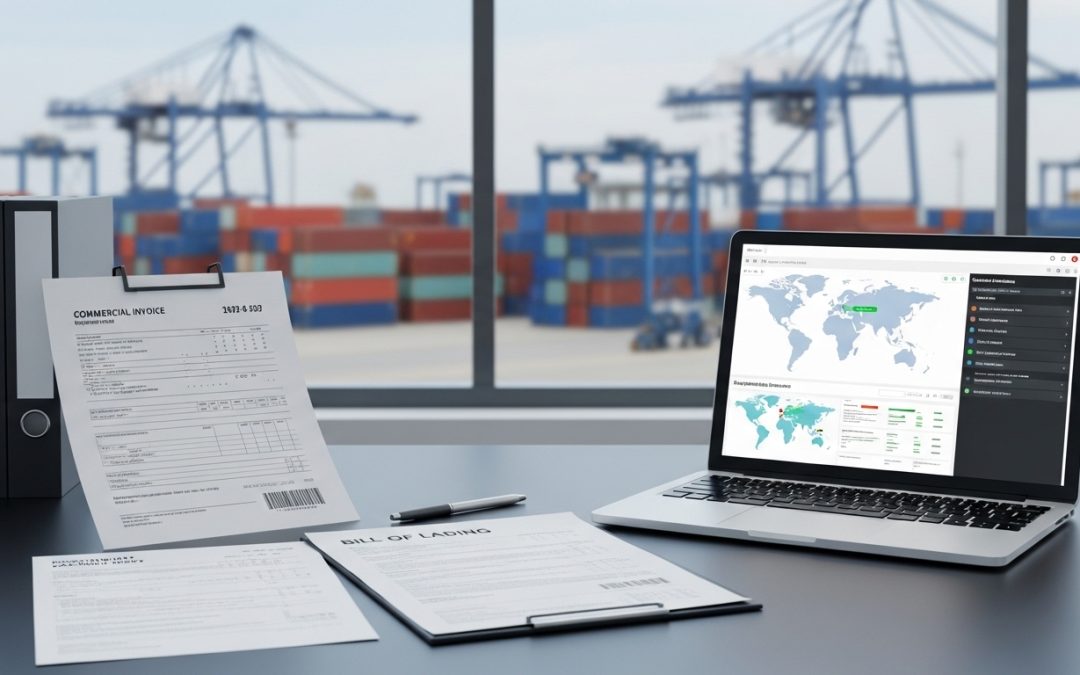
Most international shipping problems don’t start at the port, the airport, or the warehouse.
They start at a desk with a document that was rushed, misunderstood, or assumed to be “standard.”
In global freight, paperwork is not a formality. It is what determines whether cargo moves, who controls it, how much duty is paid, and whether customs will release it at all. A single incorrect line on an invoice or the wrong transport document can stop an entire shipment, trigger inspections, and create costs that quickly exceed the value of the freight itself.
This guide breaks down the key freight documents used in international shipping, explains why each one exists, and shows how to choose the right documents for your shipment, so goods move smoothly instead of getting stuck in paperwork.
What Are Freight Shipping Documents?
Freight shipping documents are the official records used to move goods internationally and domestically. They describe the cargo, define legal responsibilities, and allow authorities and carriers to process the shipment.
In practice, freight documents enable:
- Customs clearance and regulatory approval
- Legal transport contracts between shipper and carrier
- Cargo ownership and release control
- Payment, freight insurance, and risk management
Why Freight Documents Matter in Global Shipping
Incorrect or missing freight documents are one of the most common causes of shipping delays. Customs authorities rely entirely on paperwork to assess duties, verify compliance, and determine whether cargo can enter or exit a country.
When documents are wrong or incomplete, the consequences are real:
- Cargo is held for inspection or clarification
- Demurrage, detention, and storage charges begin accumulating
- Delivery timelines are disrupted
- Payment disputes may arise
- Insurance claims can be rejected due to documentation errors
The Core Freight Documents You’ll Encounter
While requirements vary by shipment, most freight movements rely on a core set of documents:
- Commercial Invoice
- Packing List
- Bill of Lading (B/L) or Air Waybill (AWB)
- Certificate of Origin
- Customs Import or Export Declaration
- Insurance Certificate (if cargo is insured)
Choosing Between the Most Important Freight Documents
Commercial Invoice vs Proforma Invoice
A commercial invoice is the primary financial document used for customs clearance. It reflects the true transaction value of the goods and is used to calculate duties and taxes.
A proforma invoice is issued before shipment, typically for quotation, internal approval, or advance payment.
Key differences:
- Commercial invoices are required for customs clearance
- Proforma invoices are used for pre-shipment or payment planning
- Customs authorities do not accept proforma invoices as final valuation documents
Bill of Lading vs Air Waybill
The Bill of Lading is used in ocean freight, while the Air Waybill is used in air freight. Although both serve as transport documents, they function differently.
Key distinctions:
- A Bill of Lading may be negotiable and act as a document of title
- An Air Waybill is non-negotiable and does not transfer ownership
- A Bill of Lading can control cargo release
- An Air Waybill primarily serves as a transport contract and receipt
Packing List vs Commercial Invoice
These two documents often cause confusion, but they serve different purposes.
- The commercial invoice focuses on financial value and customs assessment
- The packing list details how the cargo is physically packed and handled
Certificate of Origin vs Other Certificates
A Certificate of Origin confirms where goods were manufactured. This matters because:
- Import duties may vary by origin
- Trade agreements may apply
- Certain countries restrict imports from specific origins
Freight Documents by Transport Mode
Ocean Freight Documents
Typical ocean freight shipments require:
- Bill of Lading or Sea Waybill
- Commercial Invoice
- Packing List
- Certificate of Origin
- Insurance Certificate (if applicable)
Air Freight Documents
Air freight shipments typically require:
- Air Waybill (AWB)
- Commercial Invoice
- Packing List
- Dangerous Goods Declaration (if applicable)
Freight Forwarding & Customs-Related Documents
Some documents are less visible to shippers but are critical to the process:
- Shipper’s Letter of Instruction (SLI), which guides the freight forwarder
- Booking Confirmation with the carrier
- Import or Export Customs Declaration
- Power of Attorney (POA), authorizing representation before customs
EU & Middle East Perspective on Freight Documentation
In the EU and Middle East, freight documentation is subject to stricter scrutiny due to robust customs enforcement and regulatory controls.
Common regional realities include:
- Detailed verification of certificates and the country of origin
- Strong emphasis on Importer of Record responsibility
- Additional documentation requirements for regulated sectors such as technology, telecom, and medical equipment
Common Freight Documentation Mistakes to Avoid
Even experienced shippers encounter issues due to avoidable errors, including:
- Incorrect cargo descriptions or HS codes
- Inconsistencies between invoices and packing lists
- Missing signatures, dates, or official stamps
- Using the wrong transport document for the shipping mode
- Assuming carriers handle customs compliance
Getting Freight Documents Right from the Start
Freight documents are not administrative formalities—they are the foundation of compliant, predictable shipping. Most costly delays occur not because goods are unavailable, but because documents are incomplete, inconsistent, or prepared without a clear understanding of customs and carrier requirements. This is where working with an experienced freight forwarder or Importer of Record partner becomes critical—having the right support early prevents documentation issues before they reach customs.
When documentation is prepared correctly from the start, shipments move with fewer inspections, lower risk exposure, and predictable delivery timelines. Partnering with professionals who understand both freight operations and regulatory compliance helps keep goods moving instead of stuck in paperwork.
FAQs
Who prepares freight shipping documents?
Responsibility is usually shared. Shippers provide commercial and cargo details, freight forwarders prepare transport-related documents, and customs brokers or agents handle declarations. Clear coordination between all parties is essential to avoid errors.
Are freight documents different for air and sea freight?
Yes. Air and sea freight use different transport documents and follow different legal frameworks. While some supporting documents are similar, transport-specific paperwork must always match the mode used.
What happens if a freight document is missing or incorrect?
Shipments may be delayed, inspected, or placed on hold until corrections are made. In some cases, fines, storage charges, or rejected customs declarations can occur, increasing both cost and transit time.
Do all shipments require the same documents?
No. Document requirements vary based on the type of goods, origin and destination countries, transport mode, and whether the cargo is regulated. Some documents are mandatory, while others are conditional.
Can a freight forwarder handle freight documents?
Yes, freight forwarders and IOR/EOR partners can manage documentation on behalf of the shipper. However, accurate information must still be provided by the shipper, as legal responsibility for declarations ultimately rests with the importer or exporter.