

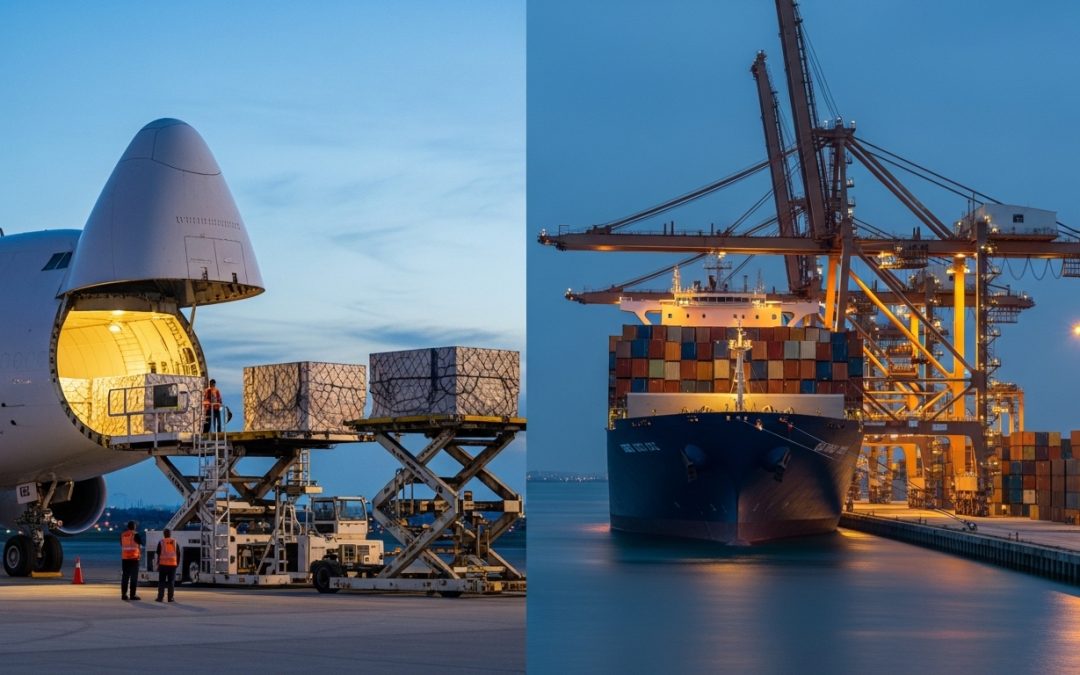
Choosing between air freight and ocean freight usually comes down to one practical question: how much risk can this shipment carry?
Both options work. Both fail when used for the wrong reason. Air freight protects time-critical operations but increases cost. Ocean freight controls cost but depend heavily on planning accuracy. Problems start when companies treat this as a pricing decision instead of a supply-chain one.
This article explains how experienced logistics teams choose between air and ocean freight based on real operational constraints — not assumptions about speed or cost.
Quick Comparison: Air Freight vs Ocean Freight
| Factor | Air Freight | Ocean Freight |
| Transit time | Days | Weeks |
| Cost level | High | Low to medium |
| Best suited for | Urgent, high-value cargo | Planned volume shipments |
| Capacity & weight | Limited by aircraft | Very high (FCL & LCL) |
| Reliability & frequency | High frequency, flexible | Fixed schedules |
| Carbon footprint | Higher per ton | Lower per ton |
| Risk & handling | Fewer handoffs | Longer exposure |
The 6 Key Questions to Decide Between Air and Ocean Freight
How Urgent Is the Delivery?
Urgency is not subjective. It is measured by impact. If a delay would stop production, delay installation, or breach a customer commitment, air freight becomes a risk-control decision. Ocean freight works when timelines are flexible and agreed in advance.
What Are You Shipping (Value, Shelf Life, Sensitivity)?
High-value electronics, pharmaceuticals, and sensitive equipment are often moved by air because exposure time matters. Lower-value, stable goods can tolerate longer transit without increasing risk.
How Big or Heavy Is the Shipment?
Aircraft are constrained by weight and volume. Once shipments become heavy, dense, or oversized, air freight becomes inefficient or impractical. Ocean freight scales better and absorbs volume with fewer compromises.
What’s the Budget vs the Cost of Delay?
Freight cost is visible. Delay cost usually isn’t — until it shows up as idle labor, emergency shipments, penalties, or lost revenue. Many air shipments are approved not because they are cheap, but because delays are expensive.
How Predictable Is Your Supply Chain?
Ocean freight depends on accurate forecasting and stable replenishment cycles. Air freight provides flexibility when demand shifts, schedules change, or recovery is needed after disruption.
Do You Need Flexibility or Contingency Options?
Air freight allows faster rerouting, split shipments, and mode switching. Ocean freight rewards commitment but offers fewer recovery options once cargo is in transit.
Cost Structure Differences Between Air Freight and Ocean Freight
Air and ocean freight follow very different pricing logic.
Air freight is charged based on chargeable weight — whichever is higher between actual weight and dimensional weight. Lightweight but bulky cargo often costs more than expected.
Ocean freight depends on container strategy:
- FCL (Full Container Load): fixed cost per container
- LCL (Less than Container Load): charged per cubic meter
Transit Time, Reliability & Schedule Variability
Air freight is fast, but speed does not guarantee predictability. Capacity constraints, security checks, and weather still cause delays — though recovery is usually faster.
Ocean freight involves longer transit and greater exposure to disruption: port congestion, blank sailings, rolling, and transshipment delays. Once cargo is on the water, options are limited.
Speed reduces exposure. Planning reduces cost.
Capacity, Cargo Restrictions & Suitability
Mode choice is also constrained by cargo characteristics:
- Hazardous goods face stricter limitations by air
- Oversized cargo may exceed aircraft dimensions
- Temperature-controlled shipments require different handling by mode
- Packaging standards vary significantly
Carbon Footprint & Sustainability Considerations
Ocean freight is significantly more efficient per ton-kilometer. Air freight has a higher carbon footprint and is often reserved for exceptions rather than routine flows.
In practice, sustainability improvements come from planning accuracy — reducing the need for last-minute air shipments.
Best-Use Scenarios
Air Freight Is Typically Best For
- Urgent shipments
- High-value goods
- Critical spare parts
- Short shelf-life products
Ocean Freight Is Typically Best For
- Heavy or bulky cargo
- Cost-sensitive shipments
- Stable replenishment cycles
- Long-term inventory planning
Air Freight When Time Matters & Ocean Freight When Cost Planning Matters
At a strategic level, this decision is about time versus planning discipline.
Air Freight — When Time Is the Priority
Air freight is chosen when:
- Operational downtime must be avoided
- Deadlines are fixed
- Delay cost exceeds freight cost
- Recovery speed matters
Ocean Freight — When Cost Planning Is the Priority
Ocean freight is preferred when:
- Volumes are high
- Budgets must be controlled
- Inventory buffers exist
- Supply planning is stable
| Decision factor | Better fit |
| Time certainty | Air |
| Budget control | Ocean |
| Large volumes | Ocean |
| Emergency recovery | Air |
EU & Middle East Perspective on Choosing Air vs Ocean Freight
Between the EU and the Middle East, the decision is influenced by customs procedures, congestion patterns, and hub strategies. Ports offer scale but less flexibility. Airports offer speed but tighter controls.
Many companies consolidate cargo in EU hubs, then choose air or ocean based on urgency and destination requirements.
Choosing the Right Mode for Your Supply Chain
There is no universal answer. Air freight and ocean freight are tools used for different levels of risk.
Ocean freight works when planning is accurate, and timelines are flexible. Air freight is used when time becomes the risk and recovery speed matters. Strong supply chains are designed to use both, not to default to one.
This is usually where experienced teams pause and double-check assumptions around lead time, inventory, and the real cost of delay before booking.
If you’re deciding between air and ocean for a specific shipment or lane, a quick operational review upfront often prevents costly corrections later.
The right choice is not about preference.
It’s about the cost of being wrong.
FAQs
Which mode is better for fragile goods?
Often, air freight has shorter exposure times and fewer handoffs. That said, well-planned ocean shipments with proper packaging and container selection can safely handle sensitive cargo when timelines allow.
Can hazardous goods be shipped by air or ocean?
Both modes can handle hazardous goods, but restrictions differ significantly.
Air freight has stricter limitations on quantities, packaging, and classifications. Ocean freight generally allows more flexibility but requires precise documentation and compliance with maritime regulations.
Is air freight more reliable than ocean freight?
Air freight offers higher frequency and faster recovery options when disruptions occur.
Ocean freight is reliable when schedules hold, but disruptions take longer to correct once cargo is in transit.
Can companies use both air and ocean freight together?
Yes. Mature supply chains often use hybrid strategies — ocean freight for planned volumes and air freight for exceptions, recovery, or critical shortages. This balance controls cost without sacrificing resilience.
How does sustainability factor into the decision?
Ocean freight has a lower carbon footprint per ton-kilometer.
Most sustainability gains come from planning accuracy — reducing last-minute air shipments caused by forecasting or execution gaps.
What’s the most common mistake when choosing between air and ocean freight?
Treating the decision as a pricing comparison instead of a risk and planning decision.
The wrong mode doesn’t just increase freight cost — it amplifies operational exposure.